Plaster Repair
Cracked, bulging or loose plaster on wood lath, reattached and skim-coated.
How plaster on lath is repairedCracked plaster, storm-stained ceilings, flood-soaked lower walls and holes in drywall, rebuilt flush, given the same surface grain as the rest of the room, and left so one coat of paint runs over old and new alike.
Calling puts the repair on the books; a local pro then goes over the damage with you and prices it.
Call 7 days, 7am–9pm
Your phone rings next: a drywall pro from this part of the county asks about the damage and then quotes it.
Drywall and plaster work makes two kinds of mess: wet compound that drips and fine dust that drifts. Careful work deals with both of them from the outset. Canvas or heavy paper goes down over the floor, taped along its edges, and furniture is moved away from the wall or wrapped in plastic sheeting.
Dust matters most when a patch is sanded. Every vent and grille in the room gets taped over so the air handler cannot spread dust to other rooms, and an open doorway can get a hanging sheet of poly with a zippered slit. Many pros sand with a vacuum attached to the sander, or wet-sand the final coat with a sponge, which keeps most of the dust out of the air.
Plaster brings its own mess. The historic district in central Tarboro holds 364 contributing buildings dating from the late 18th through the early 20th centuries, before drywall came into general use, when interior walls were plastered by hand. Opening old plaster releases hard, gritty sand and lime dust, so the containment around a plaster repair needs to be tighter than for a small drywall patch.
What helps ahead of time: clear shelves and wall hangings within a few feet of the damage, move small items out of the room, and mention pets, delicate flooring or anyone in the house with breathing trouble during the pricing call. Ask the pro how the area will be covered and how sanding dust will be handled, so you know what the room will look like during the job.
Most wall and ceiling damage announces itself in a few familiar ways. The list below pairs each sign with its usual cause and the page that covers the repair.
| What you see | Usual cause | Where it is covered |
|---|---|---|
| Tea-colored ring or yellowed patch overhead | Water from a roof, flashing, an upstairs bathroom or an air-conditioning drain line | Ceiling Leak Repair |
| Ceiling sagging or bulging downward | Water held above the board, or plaster that has let go of its lath | Ceiling Leak Repair |
| Web of fine cracks on an old wall, or plaster that gives when pressed | Plaster keys broken off behind the surface | Plaster Repair |
| Diagonal crack from the corner of a door or window | Framing movement, settling or seasonal humidity swings | Wall and Ceiling Crack Repair |
| Straight crack or bubble along a seam | Paper tape that has let go of the seam, frequently from damp or too little mud beneath it | Wall and Ceiling Crack Repair |
| A line of little raised dots | Nail pops, where fasteners push outward while studs shrink | Drywall Patching |
| Puffy, crumbly board low on the wall, or a tide line | Water that stood on the floor and wicked up into the gypsum | Water-Damaged Drywall Repair |
| Round hole behind a door | A doorknob strike where there is no door stop | Drywall Patching |
A mark that keeps growing, feels damp or smells musty points to a water source that is still active. Track down and stop that source first; a patch over live water fails.
Five kinds of repair cover nearly all wall and ceiling damage in a house. Each card opens a page on causes, how the fix is done and what moves the price.
Cracked, bulging or loose plaster on wood lath, reattached and skim-coated.
How plaster on lath is repairedWalls and ceilings soaked by flooding or plumbing leaks, opened, dried and rebuilt.
Flood and leak damage to wallsRings, damp patches and drooping board left by roof or pipe leaks, sealed or swapped out.
Stained and sagging ceilingsSettling cracks, split seams and plaster cracks, opened, taped and coated so they hold.
Fixing cracks so they holdDoorknob holes, anchor holes, dents and nail pops, patched, textured and primed.
Patching holes of every sizeDescribe what happened and where. A single sharp picture, with a quarter or a yardstick next to the damage, explains more than paragraphs. We take down the details and the best times to reach you.
An independent drywall contractor active around Tarboro discusses the damage with you by phone and settles on a figure before the wall is touched. If the cause is still active, such as a roof leak, that comes first.
Once the quote is agreed, the job goes on the calendar. Larger repairs, and anything with several coats of compound, can take more than one trip because each coat has to dry.
Damaged material is cut out or secured, new board or a plaster base goes in, and layers of compound bring the surface up flush with the old wall and its texture.
Sanding and a coat of primer even out how the new surface absorbs paint compared with the old. Ask the pro ahead of time if you want the final coat of paint included.
There is more on how the service is set up, and a checklist of what to gather first.
Usually, yes, but size is only one factor. The number of coats, drying time between them, whether texture has to be copied and whether the repair reaches into a ceiling all change the work involved.
Filled, or covered with a mesh or backed patch, then built up in two or three skims before sanding and primer. Often one trip plus a return for the final coat.
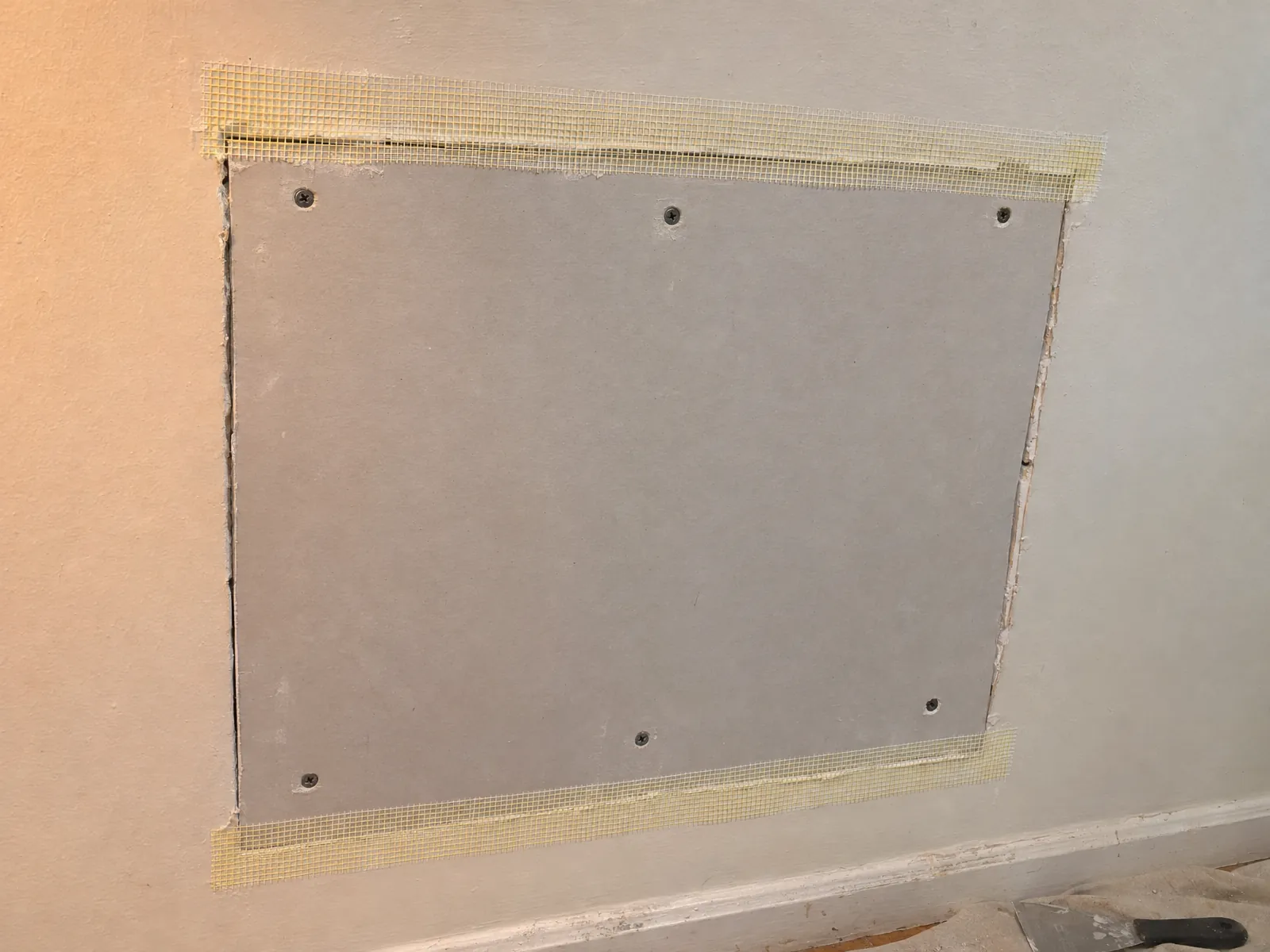
A piece of new board or a backed patch, taped joints, three coats with drying between, texture copied where the wall has one, then primer.
Sections of board replaced or plaster reattached and skim-coated, joints taped across several feet, more coats, more drying, and a wider area to blend and prime.
As a rough yardstick, the 2026 Inch Calculator cost guide lists $60 to $200 as the national average for a small drywall fix, and $300 to $900 for one big repair or a handful of small ones. Thumbtack's national figure for ceiling drywall work runs from $354 to $1,064. None of those figures is a Tarboro price. The local pro works out yours once the damage has been described and photographed.
Not every house in town is plaster. Drywall replaced plaster as the usual wall finish in American houses in the decades after World War II, and houses framed and boarded since then have their own set of problems.
Nail pops are the most common. Framing lumber keeps drying after a house is built; as a stud shrinks, the nail or screw holding the board stays put and its head pushes through the finish. The proper repair is to drive a new screw just beside the old fastener, sink the original slightly deeper, and cover the two with compound.
Truss uplift is a gap at the ceiling line, where an interior partition meets the drywall overhead. Roof trusses can bow upward slightly when the attic is cold and dry and settle back when it warms, which opens and closes the joint with the seasons. Re-taping that corner tends to fail again; a common fix is to fasten the ceiling board so it can float, or to cover the joint with a crown molding attached only to the ceiling or only to the wall.
Settling cracks run at an angle from the corners of doors and windows. A thin crack that stays the same width is usually cosmetic and is repaired with tape and compound. A crack that widens over the months, together with doors now rubbing in their frames, is a question for the foundation first.
Below are typical examples, not accounts of particular houses, each with what the fix usually involves.
Crumbled gypsum gets trimmed into a tidy square, wood cleats and a fresh insert of board fill the opening, joints are taped and coated, and primer finishes it. Fitting a door stop prevents a repeat.
The leak at the tub, toilet or supply line is fixed first. Dry, firm board just needs the mark locked in under a stain-blocking coat. If it is soft, that section is cut out and replaced.
The crack is widened a touch so compound can bite, loose plaster around it is reattached to the lath, and the area is taped with fiberglass mesh and coated so it blends with the old wall.
Soaked board is removed to a line above the stain, insulation comes out, the open cavity dries until meter readings say so, and fresh board with finished seams closes it up.
Yes. Repairs are arranged across this part of Edgecombe County, on either bank of the Tar River, and over into Pitt County.
A sentence or two on each place is on the Tarboro-area communities page.
The calendar for a repair depends less on the size of the hole than on the number of coats it needs. Joint compound has to dry, or set, before the next coat goes on, and a coat that is sanded too soon shrinks and cracks later.
Setting-type compound cures chemically, so another coat can follow within the same afternoon. Premixed compound dries by evaporation, so it is slower, and slower still in a humid house. NOAA's 1991-2020 climate normals put Tarboro's yearly precipitation at 47.59 inches, and humid summer air slows compound and primer both.
A small patch can be finished in two short trips. A flood cut or a large plaster repair can take several, with drying gaps in between. The pro can give a realistic schedule once the size and type of damage are known.
Call using the header link, or message a snapshot with one line on the room and the cause. Pricing is settled before anything starts.
After you hang up, a drywall pro serving this county follows up to settle what the job covers and what it costs.